
THE BRITISH ARMY’S 20:40:40 SOLUTION TO THE ‘SURVIVABILITY PARADOX’
Russia’s invasion of Ukraine has brutally validated an old truth about modern war: it requires not just military forces in the field but the societal ability to regenerate, outproduce and outlast. As the British Army’s Chief of the General Staff observed in January 2026, “Russia is not looking at your front lines, they’ve priced that in. They will only take you seriously when it comes to deterrence, and strength, when they see your factories producing at wartime production rates.”
This article outlines the British Army’s emerging ‘20:40:40’ concept that offers a solution to what Phillips-Levine et al recently identify as the “survivability paradox” – the vicious “self-reinforcing cycle” where “scarcity drives concentration, concentration incentivizes survivability, survivability increases costs, and rising costs further constrain force size.”.
Operational imperative
Consensus academic and military analysis of the Russo-Ukrainian War has concluded that modern wars between near-peers will almost certainly remain as attritional as those of the past, which means, “as [a] conflict drags on, the war is won by economies, not armies”. Today, the industrial scale of Russia’s war effort is immense and continues growing. In 2024 it produced approximately 1,500 tanks and 3,000 other Armoured Fighting Vehicles (AFV) whilst achieving 85% of their recruitment targets despite the pressures of economic sanctions and mounting casualties. The reality is that Britain cannot match such a defence industrial output, but nor should it seek to. Instead, it should pursue an asymmetric advantage “by making the component more survivable to protect the investment [force].”
The 20:40:40 concept is the logical corollary and draws on lessons from Ukraine that show the battlefield application of drones and combines them with extant British Army doctrine to achieve distributed lethality. The British Army will not simply incorporate emerging technology into an old-style fighting system but will instead rewire the system.
Defining the Layers of Distributed Lethality
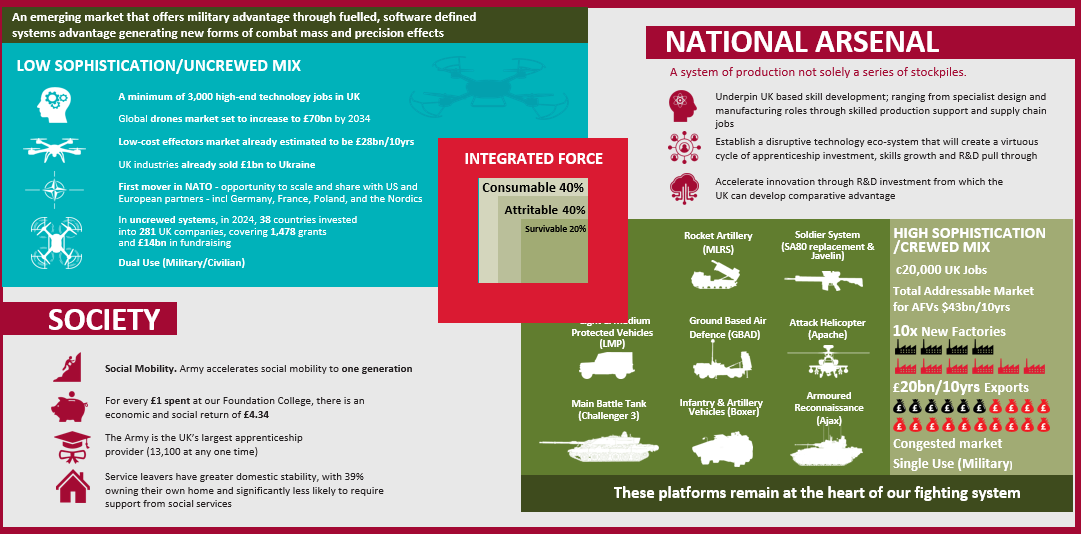
The concept of 20:40:40 describes broad proportions of the force – people, platforms, software and sustainment – that are designed to ‘endure, be risked or be expended’ to keep the combat network functioning. The British Army does not seek for every formation or unit to become ‘20:40:40’ but rather that the whole force will apply the concept differently by role and echelon. It is the Land component within the broader Integrated Force that harnesses and integrates together cross-domain capabilities alongside the other single services.
20:40:40 was announced in June 2025 (image above) and is to be the British Army’s most significant conceptual evolution in generations. It is a deliberate move away from platform-centric to a network-centric approach warfare and seeks to maximise lethality by layering ‘Reconnaissance Strike’ (or ‘Recce-Strike) combat systems of crewed / uncrewed sensors and effectors. It is designed to dismantle a peer adversary’s fighting systems whilst protecting and preserving friendly combat power, an approach many will recognise from ‘systems warfare’.
At the centre is a relatively small numbers of crewed ‘Survivable’ platforms (20%) that are the backbone of the tactical force. These are expensive capabilities such as armoured vehicles, helicopters or dismounted infantry that take longer to produce and thus replace which is why survivability is key. They are fundamental to achieving land manoeuvre and critical to missions such as seizing and holding terrain by maintaining Command and Control (C2) as well as Communication Information Systems (CIS) coherence.
Surrounding them will be a distributed layer of reusable uncrewed ‘Attritable’ (40%) platforms. They will cost less than those in the Survivable layer and are designed to operate at extended reach whilst still having significant technologically lethality. Their destruction is expected eventually but rapid replacement will be available. They will work to shield the inner layer through a synchronised CIS network that allows them to be remotely piloted or autonomously controlled. The more sophisticated models of Uncrewed Aerial and Ground Vehicles (UAS / UGVs) would be used in this layer – either sensors or effectors.
Finally, the third outer layer will be comprised of cheap mass ‘Consumable’ (40%) capabilities – such as One-Way Attack (OWA) or First Person View (FPV) drones as well as decoys and Electronic Warfare (EW) systems. These would be quick and simply to produce, intended for short durations to deliver a specific tactical effect. Their value would be in scale – overwhelming localised enemy Anti-Access Area Denial (A2AD) networks or uncoupling their targeting cycles to enable friendly force action.
Survivables take the longest to produce and are therefore the most vulnerable to technological obsolescence; however, this can be offset by platforms having open-architecture software and modular upgrades. Fundamentally, they will also always be employed alongside Attritable and Consumable systems that are able to be iteratively upgraded and evolved quickly. Ensuring common CIS standards and compatibility protocols will be vital to enable seamless integration across unit, formation, service and nation. Taken holistically, the 20:40:40 fighting system has the potential to deliver the optimum ‘unconstrained mass’ effect that Phillips-Levine et al concluded would mean “it can overwhelm a threat system without reliance on individual platform survivability.”
What next?
To be conceptually credible and effective on the battlefield the British Army’ 20:40:40 concept requires near and long-term financial and economic resource. Optimistically, the British Government has already set the necessary conditions with the Strategic Defence Review 2025 (SDR25) and Defence Industrial Strategy (DIS) have committed the administration to “the largest sustained uplift in defence spending since the Cold War”. However, it cannot depend on state or public finance alone.
The importance of the commerical and defence technology sector in modern warfare is only growing. CGS was explicit in saying “industry and the world of finance must become the fourth arm of defence.” This has seen the development and rapid expansion of Mission Partnering across British Defence as commerical expertise is brought alongside formations, units and individual soldiers to enhance lethality. Today the UK MOD has 48 ongoing drone-related contracts valuing £3.6 billion and increased its investment tenfold in 2025 to increase its UAS and UGV drone production from 10,000 to 100,000. Mission Partnering is occurring across the whole force and was proven in field trials by 4 Brigade in Estonia using the Army’s Dismounted Data System (DDS). Task Force RAPSTONE is another initiative demonstrating wartime urgency in peacetime by “investing over £200m in British systems that equip those forces that have just been earmarked for potential operations”.
Ultimately, the Survivability Paradox described by Phillips-Levine, Tenbusch and Mills threatens the British Army just as much as it does the US military and every other NATO member. Ukraine continues to provide real-world evidence of how “a handful of soldiers, literally, with the right technology, can hold numbers of kilometres of frontline where 80 years ago that would have taken thousands of soldiers.” The 20:40:40 concept offers a potential solution that can be universally applied to achieve distributed lethality, adversary system attrition and sustained by regeneration at scale.

Laurence Thomson
Laurence Thomson is a Chief of the General Staff Fellow.