
WHY BRITAIN SHOULD RESURRECT ‘LETTERS OF MARQUE’ FOR THE DIGITAL AGE
In 1708, a Bristol trading captain named Woodes Rogers departed England in command of the ‘Duke’ and ‘Duchess’, two heavily armed merchantmen, with a commission from Queen Anne authorising him to wage war against French and Spanish shipping. The letter of marque had transformed him from a private citizen into a state sanctioned privateer. Over three years, Rogers circumnavigated the globe and captured – amongst many – a prize Spanish treasure galleon worth approximately £800,000. Rogers returned home having demonstrated the value of private enterprise under sovereign aegis: strategic power could be projected with minimal Crown expense.
Three centuries later, on 18 December 2025, Senator M. Lee (R-UT) introduced S.3567 to the 1st Session of the 119th Congress. Named the Cartel Marque and Reprisal Authorization Act of 2025, it proposes to give the US President authorities “to issue letters of marque and reprisal with respect to acts of aggression against the United States by a member of a cartel”. The US Government is also reportedly considering “enlisting private companies to assist with offensive cyberattacks”. The historical inspirations are clear and the modern utility of private enterprise for British national purposes is worth considering.
What are Privateers?
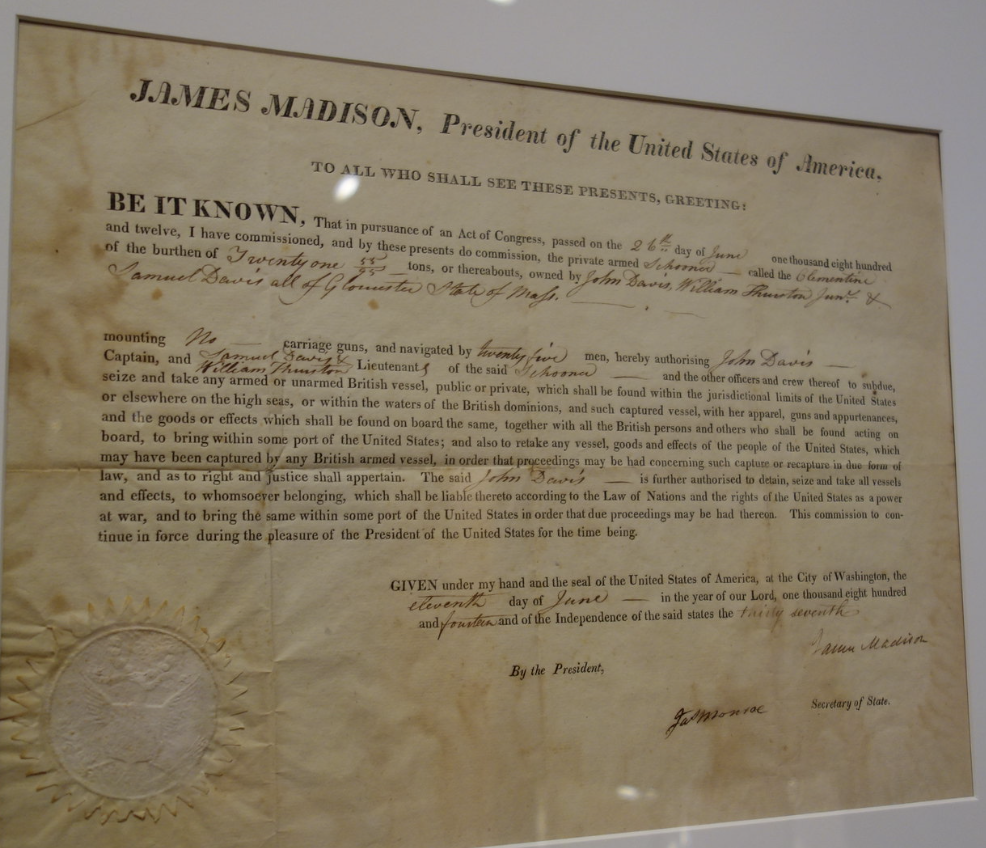
Letters of marque were state-issued licences authorising private individuals to wage war on designated state enemies. Britain once dominated privateering. Elizabeth I’s sanctioning of Drake, Hawkins and Raleigh transformed merchant adventurers into instruments of grand strategy against Spanish hegemony. The British Monarchy issued as many as 4,000 letters of marque during the Napoleonic Wars. In the war of 1812 alone, American privateers captured 1,300 British vessels. Privateering allowed governments to project power to complement or negate sovereign economic or military resource. The system worked because frameworks were clear, courts enforced rules and strategic objectives aligned with commercial incentives.
The 1856 Declaration of Paris formally abolished British naval privateering, yet in the United States the Constitution still empowers Congress to grant letters of marque under Article I, Section 8 of the US Constitution. As the national defence conversation in Britain develops, with many difficult fiscal choices that lie ahead of the Government and all departments. Meanwhile, Private offensive cyber operations are reportedly occurring daily around the world and the consequences of unregulated private cyber capabilities are already visible. The Israeli firm NSO Group was ordered to pay damages by a US federal court for using intrusion cyber capabilities in June 2025. Whilst Ukraine’s IT Army operates today as a volunteer cyber militia with tacit government blessing but minimal legal framework. The choice is not whether private actors will conduct cyber operations – they already do – but whether democracies should harness them through regulation. Not doing so may cede advantage to adversaries exploiting unaccountable proxies.
Why could it be important?
The world of Great Power Competition and the looming threat of war crystallises the defence imperative and security challenge facing Britain today. The Strategic Defence Review 2025 said “innovation and industrial power are central to deterrence and decisive factors in war”, going beyond pure military force to a ‘whole of society’ approach. The British Army stands at approximately 73,000 personnel – its smallest since the Napoleonic era and much reduced from 102,000 in 2006 – and the broader Armed Forces and security services will inevitably concentrate on protecting critical government and military networks, rather than the national infrastructure that underpins economic activity. More capacity is needed as capacity shrinks and threats expand.
Private companies and enterprise could fill this gap. British Private Military Companies (PMCs) already operate internationally and operated under international regulation. The most widely used is being the Montreux Document, which outlines the responsibilities of states, and the Code of Conduct for Private Security Service Providers. Many have moved beyond basic security to providing comprehensive services, including intelligence, training, logistics and drone operations. Writing in RUSI, Dr Joana de Deus Pereira noted that “the centre of gravity has shifted from security services to capability and data control” and that the core challenge was governance as “the commerical logic is clear”.
The British Government’s defence policy creates conditions in which regulated private companies can accelerate national objectives. Their commitment to make ‘Defence an engine for growth’ depends upon a “strong defence sector that is fit for the future” and yet procurement remains glacial. Equally, the refreshed Defence Industrial Strategy outlines ambition but the delayed Defence Investment Plan (DIP) means “damaging signals” are being sent domestic and international markets about Britain’s commitment to industrial partnership. The challenge is not capability but integration.
Cross-domain Letters of Marque
Adapted letters of marque could address capability gaps across all domains. Most readily acceptable is in cyberspace. British cybersecurity firms like Darktrace and BAE Systems Digital Intelligence are already significant market performers with recognised international standing and pedigree. Without legal frameworks authorising defensive or limited offensive cyber operations, these capabilities remain commercially constrained whilst hostile state adversaries employ unaccountable proxies. China’s relations with APT groups, Russia’s tolerance of ransomware organised crime and Iran’s cyber militia model all demonstrate how authoritarian states exploit ambiguity and the ‘grey zone’ between state and private action. Britain needs regulatory innovation to match technological capability and threat, creating the conditions by which private expertise serves national interest within democratic oversight should be the goal.
Equally, at sea, British-flagged vessels face escalating threats from Houthi attacks in the Red Sea to piracy in the Gulf of Guinea, yet RN resources cannot provide omnipresent protection. Licenced private maritime security firms already operate in these spaces but lack clear legal authority for proportionate offensive actions. A regulatory framework could authorise limited pre-emptive actions whilst maintaining accountability through Admiralty Division law court precedents.
In the air, the proliferation of Uncrewed Aerial Systems (UAS) and Russian targeting of Critical National Infrastructure (CNI) demonstrates the gap between threat and response. Granting licensed private firms the authority to deploy counter-UAS capabilities would force multiply the security service’s ability to protect installations. The logic and operational imperative in the air also applies on land. Licenced private companies could be authorised to provide armed security at designated infrastructure sites under strict rules of engagement or under the supervision of a security service operations centre. They could even be accredited to operate internationally where political sensitives preclude an official military presence but British interests are still present – supporting partner nation training, logistics etc.
Most ambitious would be in space, where information gathering and satellite protection represent a fast-emerging frontier that already overmatches the resources of UK Space Agency and UK Space Command. Private companies possess capabilities that complement government systems and even exceed them, offering a means to rapidly expand Britain’s sovereign space capability.
In each domain the principle remains the same: private capability exists, threats are expanding, and democratic states must choose between regulated integration, unaccountable chaos or being outcompeted.
A British Framework for Delegated Defence
The British Government should establish an investigative committee on ‘Delegated Defence Operations’ to include cross-party MPs, MOD, Home Office and Treasury representatives to examine whether adapted frameworks could allow testing of modern Letters of Marque. The MOD already has established mechanisms to liaise with the private sector through its ‘Mission Partnering’ initiatives and these could be expanded to enable licensed entrepreneurial action on behalf the state. Specifics considerations would include:
- CNI security. Legislation permitting licensed private contractors could deliver physical and digital security to support broader Homeland Defence and National Resilience efforts. Control measures could be put in place such as: criminal liability for unauthorised escalation; judicial oversight through reconstituted Prize Court equivalents; and certified training requirements. Estonia’s Cyber Defence League has successfully operated since 2013 and provides evidence that this model works in a state democratic system.
- Industrial Mobilisation Licensing. Authorise the MOD to issue time-limited ‘innovation licences’ to enable rapid deployment of experimental or novel technologies without full procurement competition. These licences would operate like Emergency or Exceptional Use Authorisations (EUA) in healthcare that is targeted against an identified capability gap, time-bound to 12-24 months with performance-based contract requirements and the ability for extension. Incentives should be tied to operational success.
- Private Security Operations Regulation. Replace contract-law patchwork with statutory licensing requiring parliamentary notification for conflict-zone operations, with criminal liability for international law violations. The Private Security Industry Act 2001 should be updated and the industry regulator Security Industry Authority strengthened. Enhanced parliamentary oversight would help avoid repeating mistakes such as Blackwater in Iraq.
- Professional Education Reform. The Armed Forces and Government departments need to develop doctrine on how to operate with and alongside licensed private entities. The intellectual frameworks exist and many countries offer useful comparative examples to consider such as Germany, France and Poland.
British letters of marque historically succeeded when tightly regulated with clear purpose and failed when profit eclipsed policy. The question is not whether private enterprise should participate in national defence and security – they already do, at every level – but whether Britain embraces it and regulates intelligently. This is not an atavistic call to return to an ungoverned age of the privateer. The world is different, as are the threats, but the underlying concept can evolve from ocean seafaring to digital network and from Spanish galleon to CNI. Britain once wrote the rules for delegated defence: it should write them again – or watch others do so instead.

Laurence Thomson
Laurence Thomson is a Chief of the General Staff Fellow.