
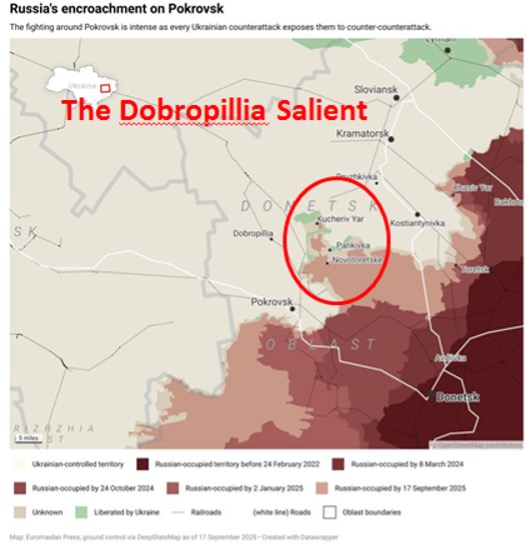
Three days before the Trump-Putin summit in Alaska on 15 August, Russian forces achieved a breakthrough on the Pokrovsk front. The timing was purely coincidental and seemed to take both sides completely by surprise. For months this sector has been deadlocked. Then, a Russian assault broke through a gap in the Ukrainian defence line and advanced almost 20 kilometres in one bound, bypassing east of the tactically important Dobropillia (pre-war pop. 28,000). Russian milbloggers crowed: could this be the turning point?
What happened?
Over a period of several months, the Russian 51st Combined Arms Army (51 CAA) redeployed almost all of its brigades northeast of Pokrovsk, including the 1st, 5th, 9th, 110th and 132nd Motor Rifle Brigades. On 12 August, a 300-350 strong grouping – drawn from 5th, 110th, and 132nd Motor Rifle Brigades exploited a gap in Ukrainian defences and reached as far north as Zolotyi Kolodyaz and Kucheriv Yar. The defenders were somewhat distracted because a major assault was underway at Rodinske at the base of the salient.
Russian forces also infiltrated Vesele cutting the Dobropillia–Kramatorsk highway near Novovodiane. If Dobropillia had been captured, the T0515 road would have been cut leaving the Ukrainian garrison in Pokrovsk dependent on just one other road for resupply.
The breakthrough (прорыв – ‘proryv’) was neither doctrinal, nor organised, nor probably even planned. There were no tanks, or AFVs involved. There was no artillery or rocket support. Incapable of meaningful combined arms warfare anyway, company-strong groups simply advanced north through a gap – it seems unopposed – on motorcycles, in pick-ups, or on foot.
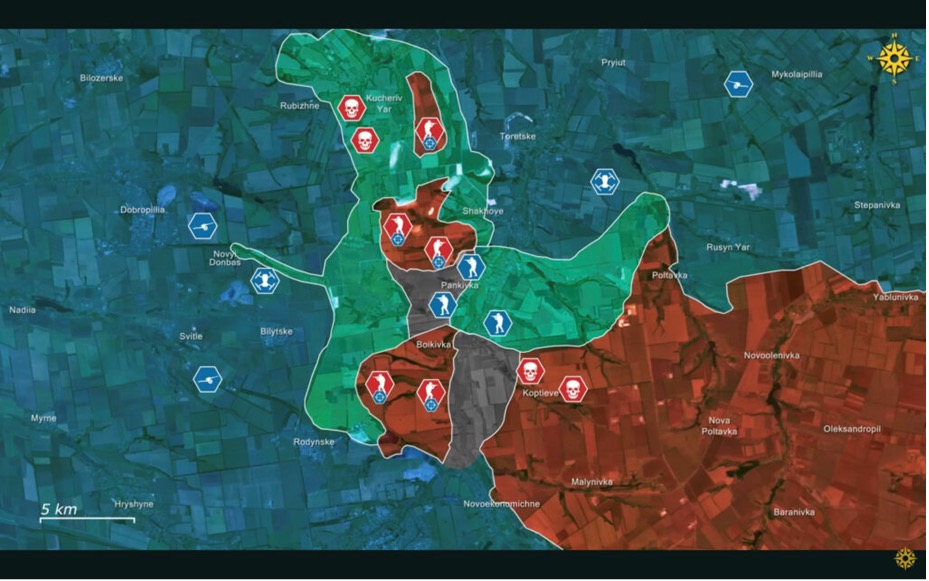
Ukrainian counter-attacks (mid-Aug – end Sep)
The Ukrainian response was quick. In addition to the 1st Azov Corps, OSUV Dnipro redeployed elements from 79th and 82nd Air Assault Brigades, 1st and 425th Assault Regiments, 25th Assault Battalion, 2nd Battalion/92nd Assault Brigade, elements from 32nd and 93rd Mechanized Brigades, 38th Marine Brigade, 14th National Guard Brigade and the Birds of Magyar drone brigade.
Ukrainian counter-attacks succeeded in blocking the penetration. Pressure from both flanks resulted in groups of Russian soldiers withdrawing into three pockets. However, the encircled soldiers sought shelter in basements and turned positions into defensive strongholds. Resupplied by drones or simply infiltrating in what continued to be a fluid situation, the three pockets were still holding out at the end of September. As retreat can have serious consequences for Russian soldiers (including execution), their resistance was perhaps not unexpected.
Russian armoured attacks (6 Oct – 27 Oct)
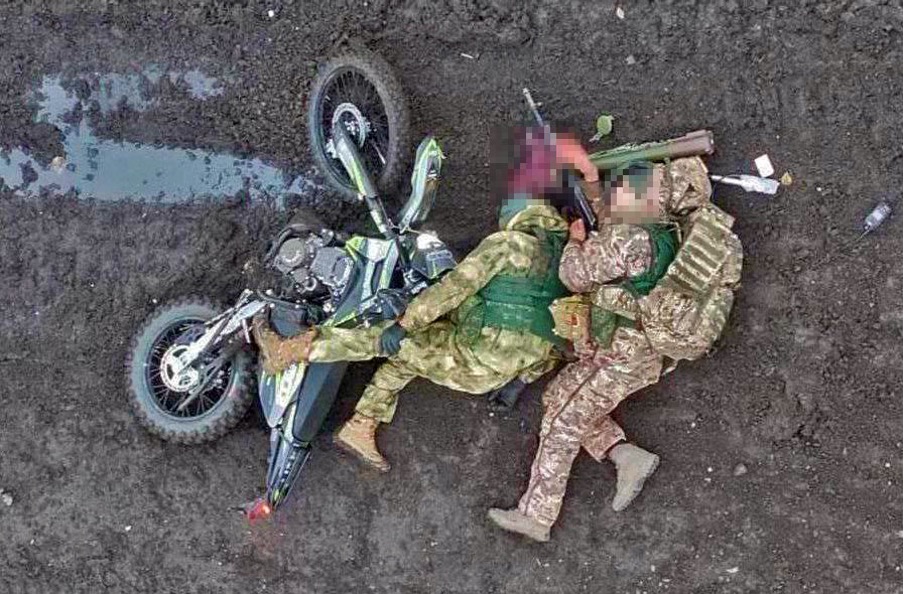
There have been almost no Russian armoured attacks since the spring because the Russian Army has run out of tanks and AFVs. There was considerable surprise then when five company-level armoured attacks were attempted in the Dobropillia salient over a three week period in October. They followed the same pattern and all failed.
There are no combat estimates or orders as understood by a Western army. There is no recce. The assaults are mounted in daylight because the Russian Army lacks night sights. Vehicles line up in a ‘follow-the-leader’ column, typically led by a ‘turtle tank’ (a tank covered in steel plates and logs). The advance is made on a single route. Motorbikes race ahead. There is no indirect fire support because the Russian Army lacks a working tactical network so cannot call for fire. There is no engineer support. There are no flanking actions. There is no surprise or deception. Poor weather is used (low cloud) as cover from Ukrainian drones. There is saturated jamming but this inhibits Russian drones; Ukrainian drone pilots get through.
Once the lead vehicles are checked – by a combination of obstacles, artillery fire and drones – chaos ensues and assaults collapse. Surviving infantry seek shelter in basements. Anyone caught in the open is eventually killed or maimed by predatory drones. Ukrainian drone pilots commonly record Russian soldiers committing suicide.
| Date | Location | Unit | Total vehicles | Destroyed Vehicles | ||
| Tanks | Armoured Vehicles (tracked or wheeled) | Motorbikes | ||||
| 6 Oct | Pankivka | 20 MR Div unit? | N/K | 4 | 8 | – |
| 9 Oct | Shakhove, Volodymyrivka | 155 Marine Bde, 40 Marine Bde | 35 and 40+ bikes | 3
Poss T-80BVMs |
16
BTR-82As |
41 |
| 13 Oct | Shakhove | 155 Marine Bde, 5 MR Bde | 16 and U/K bikes | 3 | 13 | 3 |
| 16 Oct | Shakhove, Volodymyrivka | 155 Marine Bde | 22
(A higher number of 46 has been cited) |
– | 9 + 4 damaged | – |
| 27 Oct | Shakhove, Volodymyrivka | N/K | 29 | 4 | 8 + one wheeled vehicle
(Included 2 x BMP2, 1 x MT-LB) |
– |
The first attack was mounted on 6 October. This involved a reinforced company-sized mechanized assault near Pankivka (east of Dobropillia). Four tanks and eight armoured vehicles were damaged or destroyed. Three days later, around 35 armoured vehicles, spearheaded by over 40 motorbikes, attempted to rush the village of Shakhove. These were likely marines from 40th and 155th Naval Infantry Brigades (two formations that have been destroyed and reconstituted multiple times). Three tanks and 16 armoured vehicles were destroyed. All the motorbike teams were killed by artillery fire or drones.
South-east of the village of Novotoretske, the assault resulted in what was later described as a ‘razor wire massacre’. It appears the assaulting group wholly miscalculated the difficulties of overcoming two razor wire barriers extended between dragons teeth. Over 50 Russian dead could be counted in this single location (two weeks later the corpses had still not been retrieved attracting the attention of stray dogs and feral pigs).
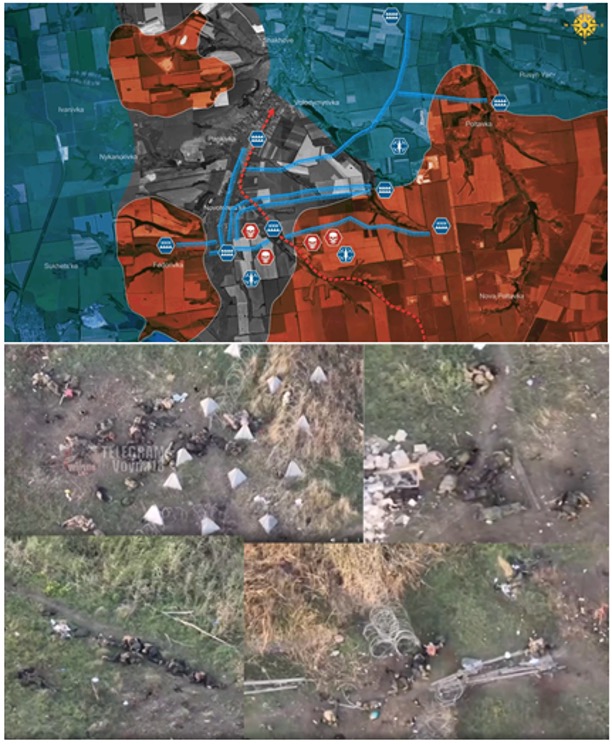
On 13 October the marines tried again on the same axis, supported by the 5th Motor Rifle Brigade. There were two waves of attacks. The first wave involved seven APCs; all were destroyed. The second wave was led by two ‘turtle tanks’, another seven APCs, and motorbikes. An ammonia pipeline to the east near a village named Rusyn Yar was blown, releasing a cloud of toxic gas. This caused confusion and panic amongst Ukrainian defenders but also caught out the Russian attackers.
A Russian deserter later described what happened: ‘On October 5–8, in the area of Rusyn Yar, a village in the Donetsk region, the 33rd, 57th, and 242nd regiments were conducting offensive operations. That was when the ammonia pipeline was exploded. The offensive was just awful. All the equipment was burned, and a huge number of men died. A pointless attack.’
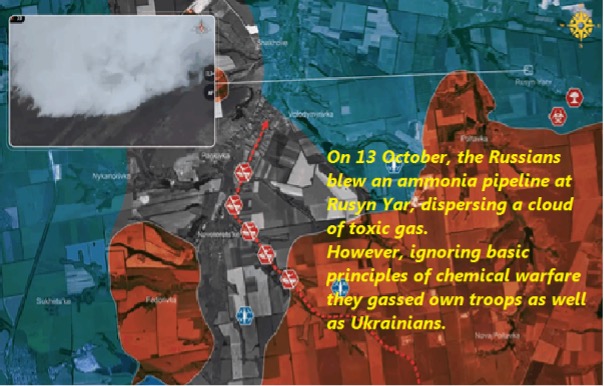
The fourth attack was mounted on 16 October. 40th Marines Brigade was likely involved. Between 05:30hrs and 08:00hrs, the Russians launched an assault involving 22 armoured vehicles. The largest column – 11 vehicles – moved out from the village of Malynivka. Other vehicles had been concealed in treelines. The attacks collapsed in the face of prepared Ukrainian defences. Alternative reporting suggests a higher number of six tanks, including one ’turtle tank’, over 40 APCs, 40 motorcycles, and several hundred troops were involved. However, the available video evidence and vehicle casualty numbers suggest the lower number of 22 is more likely.
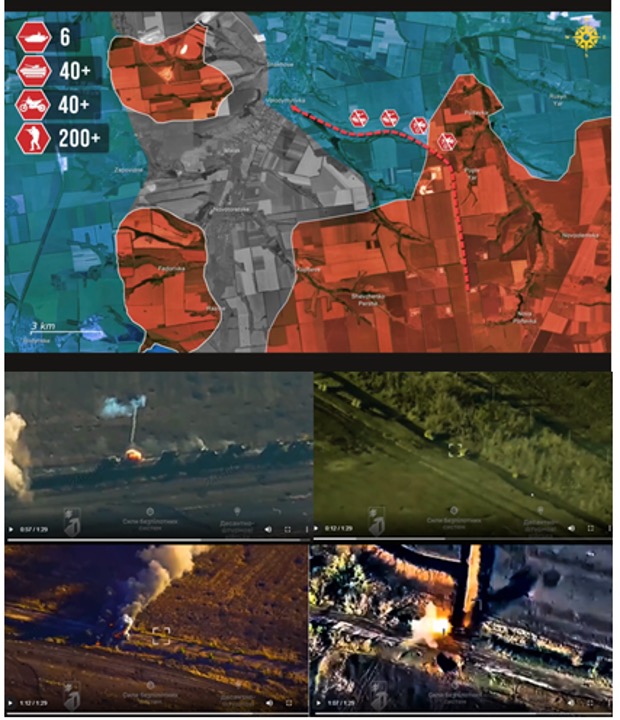
On 27 October the Russians tried again on the same axis using 29 armoured vehicles advancing in groups of 4-5 under cover of bad weather. They were checked by 1st ‘Azov’ National Guard Corps and 33rd and 93rd Separate Mechanized Brigades. The action lasted six hours before the Russians were forced to withdraw with the loss of 12 vehicles. In total, over October, Russian forces lost 92 armoured vehicles in the area including 24 tanks, eight BMPs, five MT-LBs, four BTRs and one BMD IFV.
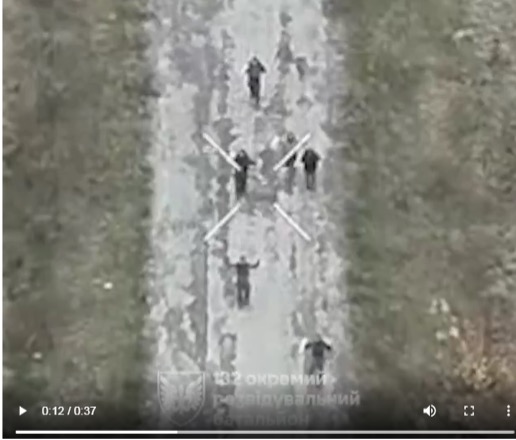
Ukrainian forces in the meantime have continued to squeeze the salient. On 22 October, 132nd Separate Reconnaissance Battalion finally succeeded in recapturing Kucheriv Yar (the most northern and isolated Russian pocket), seizing over 50 Russian prisoners. Ukrainian videos showed the usual cast of old, ill and half-literate Russians.
So what do we learn?
This war is mired. The Russian Army has become a human sewage disposal system. The pre-war army has been destroyed. All that is left is a conveyor belt of gullible, greedy volunteers hoping to make a quick buck and survive. Clueless, bullying, inept commanders repeat the same sterile, senseless tactics, week after week. The defining metric is the ragdoll corpses and body parts scattered across fields recorded by Ukrainian drones. At this rate, The Economistrecently estimated, it will take Putin 103 years to conquer Ukraine. Russia’s wobbling wartime economy, of course, would have collapsed long before that milestone.
The Ukrainian armed forces hold on with determination and innovation that could not be praised too much. But warfare is a numbers game and Ukraine struggles with manpower. Treasury Secretary Scott Bessent recently made the apt observation. ‘We are in a race,’ he said, ‘How long can the Ukrainian military hold up versus how long can the Russian economy hold up.’

Sergio Miller
Sergio Miller is a retired British Army Intelligence Corps officer. He was a regular contributor and book reviewer forBritish Army Review. He is the author of a two-part history of the Vietnam War (Osprey/Bloomsbury) and is currently drafting a history of the Russian invasion of Ukraine.
- Sergio Miller

- Sergio Miller
- Sergio Miller

- Sergio Miller
