
Peter Apps’s The Next World War: The New Age of Global Conflict and the Fight to Stop It is a timely and unsettling exploration of the shifting dynamics of global power, the resurgence of large-scale warfare, and the general state of international security in the 21st Century. Drawing on both his background as a journalist and extensive firsthand reporting, The Next World War is Peter Apps’s at his best. Compelling, engaging, and excellent. In many ways The Next World War is a history of the future.
At its core, The Next World War argues that the post Cold War illusion of peace has collapsed. Apps describes a world where great power competition has returned with renewed intensity driven primarily by tensions between the United States, China, and Russia. Rather than presenting war as a distant or hypothetical possibility, Apps frames it as a credible risk within the coming decade. A risk that is already shaping policy, military planning, and everyday life.
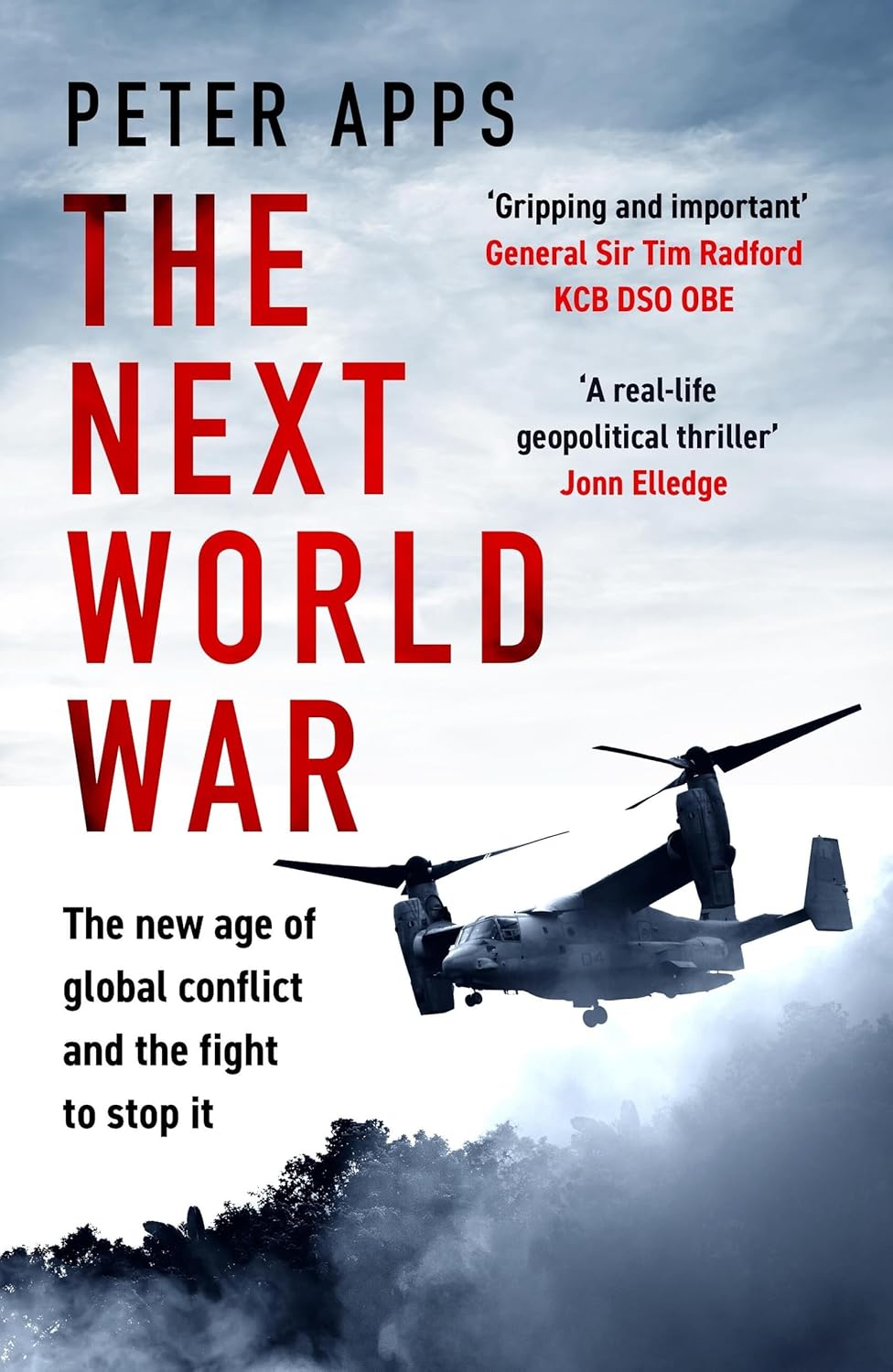
One of The Next World War’s greatest strengths is its ability to ground geopolitical tensions in real world settings. The focus on China and Taiwan, for example, are effective and his narrative makes it relevant to an average reader. Apps explores the normalcy of daily life with the looming threat of invasion highlighting how interconnected events are to normal human beings in reality. This contrast underscores one of his central arguments, and paraphrasing, that modern societies often exist in a state of cognitive dissonance, simultaneously aware of but detached from the possibility of catastrophic conflict.
Apps’s analysis of potential flashpoints is comprehensive. He examines the Taiwan Strait, Eastern Europe, the Middle East, and locks in analysis from domains like space and cyber. Each region is presented not in isolation, but as part of an interconnected global system where crises overlap. Particularly compelling is his discussion of how simultaneous conflicts, such as a Chinese attack on Taiwan coinciding with Russian aggression in Europe, could overwhelm existing military and political structures. This multi theatre and global perspective raises The Next World War from other texts which generally focus on a single-conflict analyses.
Another notable aspect is Apps’s emphasis on the changing character of warfare. He argues, and oversimplifying, that while nuclear weapons still loom in the background, most conflicts are likely to begin, and remain, in the conventional domain, at least initially. However, these conventional wars would be far from traditional. The integration of drones, cyber, artificial intelligence, and space based systems add how they add new unpredictability. Apps’s descriptions of drone warfare in Ukraine, for example, highlights both the technological sophistication and the realities of modern combat.
The Next World War also engages with the concept of deterrence. Apps revisits Cold War theories while acknowledging their limitations in a more complex and multipolar world. He suggests that deterrence today requires not just military strength, but also political cohesion, economic resilience, and societal preparedness. Finland is presented as a model of this approach, with its culture of national service and readiness serving as a counterpoint to what Apps sees as complacency in many Western nations. Linking these points The Next World War is a stark challenge to NATO policy makers.
Stylistically, Apps strikes a balance between journalistic clarity and analytical rigor. His prose is accessible without being simplistic, and he avoids excessive jargon. The inclusion of interviews with military personnel, policymakers, and civilians adds texture and authenticity, making the book engaging as well as informative.
Perhaps the most powerful aspect of The Next World War is its underlying message that the risk of global conflict is not inevitable, but it is real. And increasing. Apps does not succumb to fatalism in this. Instead, he emphasizes the role of human agency, arguing that decisions made today will determine whether the coming decades are defined by war or by successful deterrence. This perspective is both sobering and cautiously optimistic, encouraging readers to take the threat seriously without resigning themselves to it.
In The Next World War, Peter Apps has produced a compelling and thought-provoking work that captures the anxieties of a world in transition. The Next World War is not merely a book about conflict; it is a study of uncertainty, resilience, and the fragile balance that underpins global stability. It is excellent, even exceptional.
While it may not provide definitive answers, it succeeds in asking the right questions. And in doing so it serves as an important contribution to contemporary discussions about security and the future of international relations.
This book is excellent, engaging, informative and Peter Apps at his best. 11/10.

The Wavell Room Team
The Wavell Room Team are a bunch of enthusiastic individuals who believe strongly in constructive debate, discussion and openness in order to arrive at a sound, non-bias and informed position on many subjects. The team are all volunteers and support this non-profit in their own time.
- The Wavell Room Team
- The Wavell Room Team

- The Wavell Room Team

- The Wavell Room Team
