
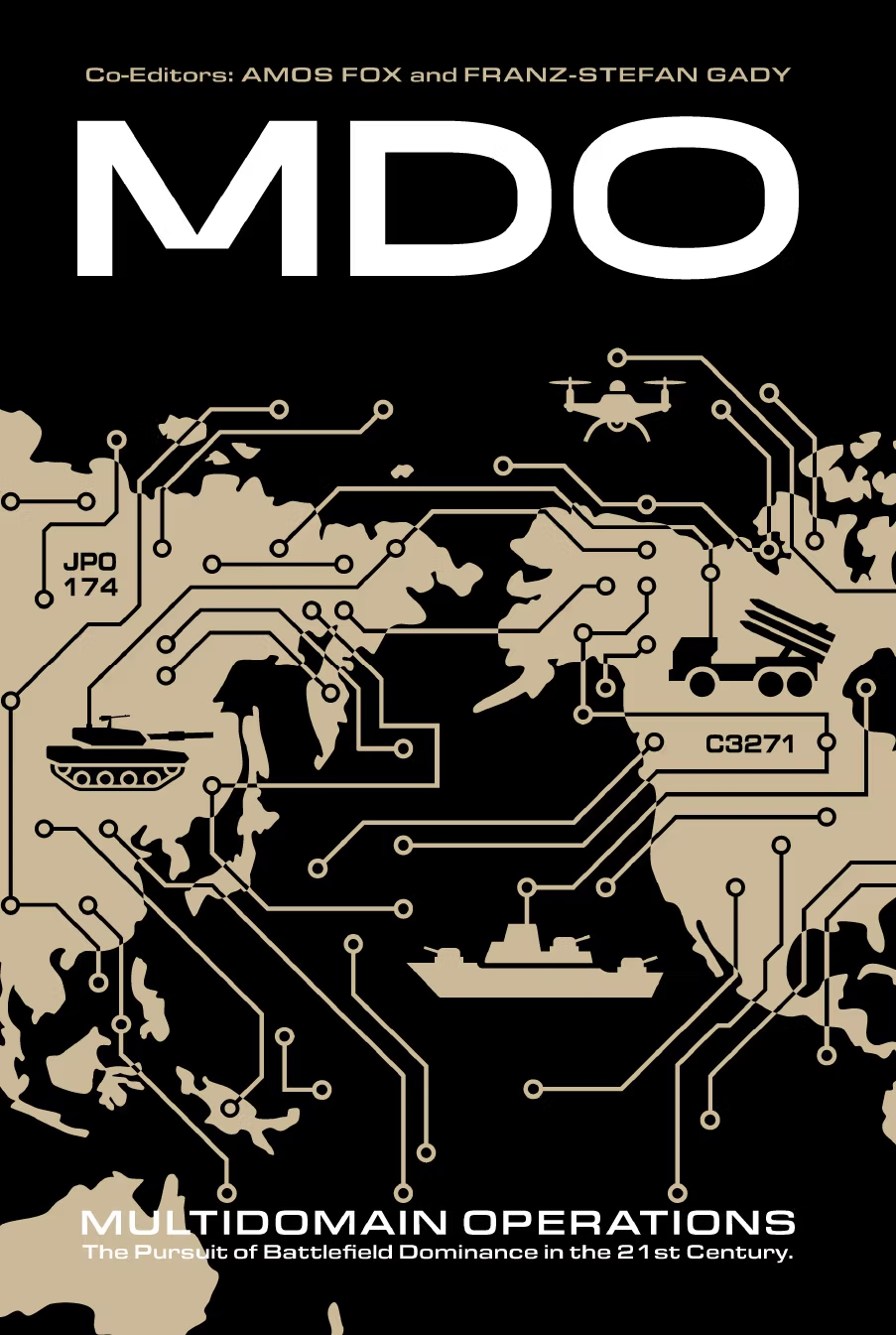
“All façade and no filler.” That characteristically blunt assessment captures the tone and thrust of Multidomain Operations: The Pursuit of Battlefield Dominance in the 21st Century, an edited volume by Amos Fox and Frantz-Stefan Gady. At a time when “multidomain operations” (MDO) has become the dominant, if ill-defined, concept in Western military thinking, Multidomain Operations sets out to interrogate its intellectual foundations, practical utility, and coherence. The result is a sustained and often damning critique of what many contributors see as a concept full of ambition but short on substance.
The volume is structured into four parts. The first explores the origins and lineage of multidomain doctrine, tracing how and where it emerged from. Part two examines the practical considerations, including force design and implementation challenges. Part three looks at tensions with contemporary conflict and tests MDO against the realities of warfare. The final section offers international perspectives that both reinforce and complicate the core critique.
At its core, and oversimplifying enormously, the book advances several interlocking arguments about why multidomain operations are not fit for purpose. First, the doctrine’s development process was deeply flawed. Contributors argue that MDO is the product of bureaucratic compromise rather than intellectual clarity, resulting in a concept shaped by institutional consensus over operational necessity. The language of MDO, replete with buzzwords such as “convergence,” “integration,” and “cross-domain synergy, is criticised as vague and imprecise. This lack of definitional clarity, particularly within U.S. military thinking, is not, according to the writers, only an academic concern. It has real implications for how doctrine is interpreted and applied undermining its potential value.
Second, the book contends that multidomain operations lack a coherent theory of victory. While MDO promises to deliver battlefield dominance through the integration of capabilities across land, sea, air, cyber, and space, it remains unclear how this integration translates into strategic success. Without a clear theory linking tactical actions to strategic outcomes, MDO risks becoming an exercise in operational abstraction.
Third, and perhaps most damagingly, Multidomain Operations argues that MDO lacks credible tactical application. Robert Rose’s chapter is particularly effective in this regard, highlighting how combat teams struggled to understand, and therefore implement, the doctrine. Rose’s argument that MDO’s “twisted roots” lie in bureaucratic compromise resonates strongly: in attempting to satisfy multiple stakeholders, the concept has become diluted to the point of impracticality. This critique aligns closely with Amos Fox’s broader argument that MDO lacks both the resources and the operational clarity required to work as intended. While much of this analysis is grounded in the U.S. Army experience, other contributors extend the critique to joint and tri-service contexts, suggesting that the problem is systemic rather than service-specific.
A recurring theme throughout the book and one echoed in other critical commentary on MDO is the issue of technological overreach. Davis Ellison and Tim Sweijs pose the provocative question: “Does the emperor have any clothes?” Their answer is, at best, uncertain. MDO is predicated on the assumption that advanced technologies, particularly in areas such as networking, artificial intelligence, and long-range precision fires, will enable seamless integration across domains. Yet many of these capabilities remain immature or unevenly distributed. As a result, the concept risks being built on a foundation of technological optimism rather than operational reality. This critique is consistent with wider debates in defence circles, where concerns about over-reliance on unproven technologies have become increasingly prominent.
The question of the adversary further complicates matters. Several contributors note that MDO lacks a clearly defined threat. Is it designed primarily to counter Russia, (of 2014) with its emphasis on mass and fires? Would it still work against the Russia of 2026? China, with its sophisticated anti-access/area-denial capabilities? Or irregular adversaries operating below the threshold of conventional war? The absence of a clear answer undermines the coherence of the concept. Doctrine, after all, is most effective when it is tailored to specific contexts. Without such context, MDO risks becoming a one size fits all solution that fits none particularly well.
Despite its largely critical stance, the book is not without nuance. Some chapters attempt to salvage elements of the concept or suggest ways in which it might be refined. Bill Murray’s contribution, for example, discusses the practical application of multidomain thinking, though it arguably reduces to a call for increased firepower at lower echelons. Elsewhere, the volume occasionally veers into highly academic territory, particularly in its discussions of terminology and definitions. Debates over the precise meanings of “joint,” “integrated,” and “multidomain”, “[other buzzword]” may be intellectually interesting, but they risk obscuring the more pressing question of whether the concept delivers tangible operational benefits.
One of the book’s notable strengths is the diversity of its contributors. Rather than presenting a single, unified argument, Multidomain Operations offers a range of perspectives that collectively build a compelling critique. This pluralism is important. It demonstrates that scepticism about MDO is not confined to a particular school of thought, but is shared across a broad spectrum of military and academic voices. At the same time, the consistency of the criticism, particularly around clarity, applicability, and technological feasibility, gives the volume a strong sense of coherence.
The international perspectives presented in the final section add to this depth. The Australian experience, for instance, suggests that movement towards more integrated, multidomain-capable forces is possible. But only with sufficient time, clarity, and institutional commitment. This stands in contrast to the U.S. experience, where the rapid promotion of MDO may have outpaced its intellectual and practical development.
An important, if somewhat underdeveloped, theme in the book is the question of alternatives. If multidomain operations are indeed flawed, what should replace them? Fox and Gady indirectly suggest that existing approaches, particularly those centred on joint and integrated operations, may already provide a more practical framework. However, the volume stops short of offering a clear alternative or argument for reversion to Air Land Battle or any other concept. This is perhaps understandable, given its primary focus on critique, but it does leave a gap. A dedicated discussion on the future of doctrine and what comes after MDO would have strengthened the book’s overall contribution. (And this is a call to arms for Fox and Gady to get writing!)
Multidomain Operations: The Pursuit of Battlefield Dominance in the 21st Century succeeds in what it sets out to do: challenge the prevailing orthodoxy and force readers to engage critically with a concept that is often taken for granted. It strips away the hype and exposes the underlying weaknesses of multidomain thinking, while also acknowledging its aspirations and potential. For sceptics, it provides a wealth of arguments; for proponents, it offers a necessary corrective.
This is not an easy read. The density of the arguments and the range of perspectives mean that it rewards careful, and in some cases repeated, engagement. Yet that is also a mark of its value. For staff college students, it offers a rigorous introduction to the debates surrounding contemporary doctrine. For practitioners and doctrine writers, it should be close to mandatory reading.
In the end, the question posed by Fox and Gady lingers: is multidomain operations a genuinely transformative concept, or simply a well-packaged idea that looks convincing on PowerPoint but falters in practice?

The Wavell Room Team
The Wavell Room Team are a bunch of enthusiastic individuals who believe strongly in constructive debate, discussion and openness in order to arrive at a sound, non-bias and informed position on many subjects. The team are all volunteers and support this non-profit in their own time.
- The Wavell Room Team

- The Wavell Room Team

- The Wavell Room Team

- The Wavell Room Team
