
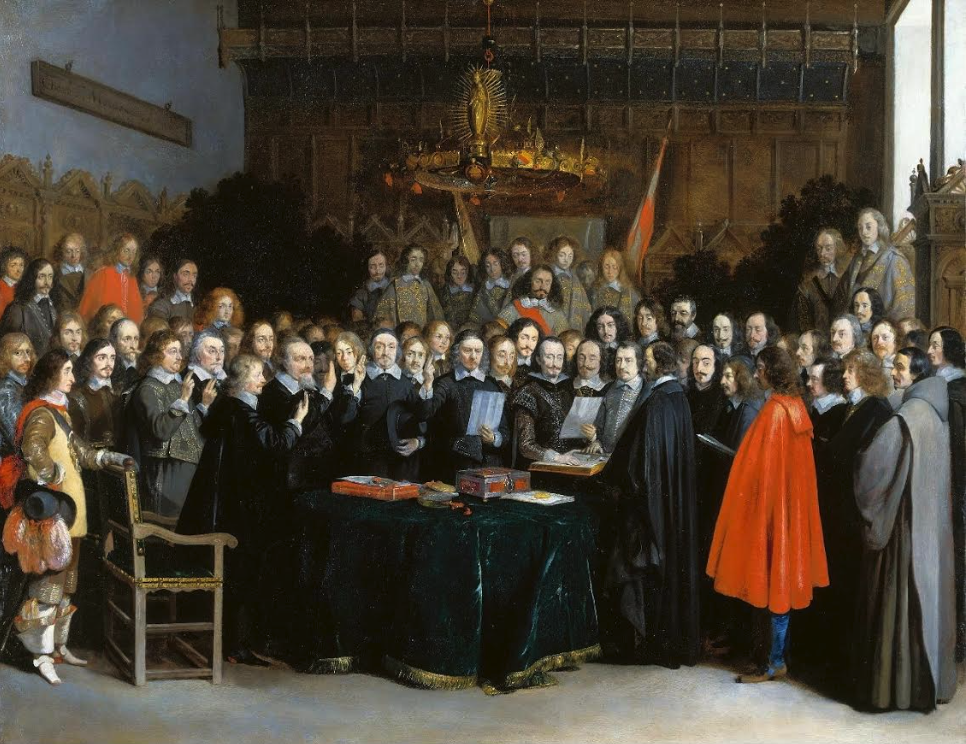
‘Power, violence and legitimacy are fragmenting, and modern conflict is starting to behave accordingly’1
Introduction
It’s hard to shake the feeling that conflict no longer behaves the way we expect it to. Wars don’t end cleanly, responsibility is always blurred, and decisions with real consequences seem to be made everywhere and nowhere at once. We sense that something has changed, but rarely have the space to stop and ask why. This isn’t an attempt to predict the next war or sound the alarm. It’s an effort to make sense of why power, violence and accountability no longer behave the way we assume they do, and what that could mean for states and societies that still expect to manage them.
Modern conflict is no longer defined by the Western conception of war as a discrete event led by states, fought by armies, and concluded by treaties. It has become a fluid spectrum shaped by states, private actors, technologies, algorithms, and societies that no longer share a common centre of gravity. The result is a geopolitical environment where the means of violence are distributed, authority is conditional, and conflict increasingly persists rather than resolves. That shift is hard to miss for anyone paying even casual attention to current events.
Conflict Without Resolution
In Ukraine, the fallout from Andriy Yermak’s resignation in November 2025 was not just another political headline. It exposed a quieter competition over who shapes the end of the war, who decides the terms of security, and which interests gain access and influence when the war eventually winds down. It is a reminder that power has never been centralised in one place, and that competing interests are now shaping outcomes more openly than before. States still matter, but they no longer control the direction of conflict or the timing of peace alone. It shows how even in a major interstate war, control over outcomes is dispersed across political factions, private funders, foreign backers and societal forces.
Power Beyond the State
In Venezuela, tensions following the American strike has little to do with drugs, rhetoric or posturing alone. Politics matters, but so do the stakes beneath it: the largest proven oil reserves on earth, critical minerals and control of commercial advantage in a region where global competitors are increasingly active. This is the type of dispute where state power, private interests and informal networks blend into one another, and where none of these actors operate in isolation or according to national logic. It is a textbook case of a conflict shaped more by markets, resources and informal networks than by state intention.
In the Middle East, Israel’s simultaneous operations across Gaza, Lebanon, Syria and the West Bank show how modern warfare behaves when too many actors hold the capacity to escalate. Fronts no longer open and close; they bleed into one another, influenced not only by governments but by proxies, foreign backers and interests that do not wear national uniforms. The result is not confusion, it is complexity. Together, these overlapping fronts reinforce a world in which the power to escalate is no longer held by states alone.
The Fracturing of Monopoly, Not the State
These conflicts should not be lumped together, but they reveal a structural reality that they now share: the state is still powerful, but it is no longer the only force that matters. Too many actors now possess the means to shape violence, stall peace or influence outcomes from outside the traditional architecture of a government. The modern battlefield has matured into something closer to a marketplace of capabilities, incentives and interests than a domain controlled solely by states.
Western strategic thinking has long struggled with this shift because its definitions of war remain narrow. Other traditions have always recognised a wider spectrum: the Russian military and strategic literature use the words borba (‘struggle’) to capture political, informational and societal contestation, and vaina (‘war’), which only refers to high-threshold armed conflict. Most modern crises sit in the space between the two. Understanding conflict as a gradient rather than an event is essential to understanding why so many disputes now stagnate instead of ending.
This Is Not New, Just Normalised
The observation that states no longer hold an exclusive monopoly over organised force is not new. Analysts, historians and practitioners have been tracking this trajectory for decades. What has changed and what demands attention now is not the existence of non-state coercive power, but the speed, scale and normalisation of its influence.
What used to be an exception operating in the shadows is becoming an organising principle of modern conflict, affecting not only battlefields but institutions, economies and the fabric of society. Most people assume governments have always controlled armies, borders and the right to use force. In reality, the era of state monopoly over violence is far younger than we typically think.
Before the State-Owned Force
For most of history, rulers did not own armies; they hired them. Security was not a national institution but a service. After the fall of Rome, when power fractured across multiple authorities, the most decisive fighting forces were not those bound by patriotism but those bound by contract. The world did not collapse into chaos, but it splintered into a marketplace of protection.
What we now label the ‘Dark Ages’ was less about barbarism and more about the distribution of power. No single authority could guarantee safety everywhere, so force followed wealth rather than citizenship, and loyalty moved with whoever could pay to secure it. None of this means today’s world is returning to the Dark Ages, but it does suggest that when states cannot guarantee security everywhere, the logic of private force re-emerges even if the tools are drones, cyber contractors and surveillance platforms rather than swords or bayonets.
Liquid Societies, Liquid Authority
This redistribution of coercive power is unfolding at the same time that many Western societies are entering what Zygmunt Bauman called ‘liquid modernity’, a condition in which individuals live in personalised informational worlds, fragmented realities and divergent interpretations of truth. When societies lose a shared understanding of events, states lose the mandate and cohesion required to manage conflict effectively. The challenge is not only external competition, but internal incoherence.
When Force Becomes a Service
That is what we are watching now. As demands on the state expand across supply chains, resources, infrastructure and personnel, non-state actors are becoming more prominent. Private security personnel now outnumber public police in many countries, and tens of millions of workers are employed in private security services worldwide. The same capabilities are being deployed in competitive environments by actors pursuing their own interests. In some cases, this support closes gaps that governments alone cannot fill; in others, it enables private advantage. The determining factor is not the category of the actor but the incentives under which they operate.
This process unfolds mostly quietly. Contractors appear where national militaries cannot go. Corporations assemble protection networks that extend across borders. Intelligence functions blend into private contracting. Militias stabilise governments that are unable to stabilise themselves. On the surface, the world still talks as if all conflict is directed by states. Underneath, coercive capability is becoming something that can be accessed, rented and leveraged once again.
Technology as Power Broker
The vacuum is not being filled solely by armed actors. Increasingly, it is being filled by companies that control the technologies on which modern conflict depends: satellite networks, AI targeting systems, battlefield decision software, cyber infrastructure and financial rails. Around 90 per cent of global cyber defence infrastructure is owned and operated by private companies rather than governments. In a world where the critical tools of war are privately owned, their owners become de facto geopolitical actors.
This technological shift has also accelerated a cultural one. Large segments of the tech elite increasingly view the nation-state as an outdated structure, an analogue institution in a digital world. The ‘Sovereign Individual’ thesis, once fringe, now shapes how many powerful actors imagine the future: individuals as micro-polities, able to defend their interests through wealth, mobility and hired capability rather than citizenship. Drones, robotics and algorithmic tools make this vision less theoretical than it once seemed.
They do not require troops or territory to shape outcomes, because their platforms already do. It forces us to reconsider what war looks like, because the shift is not from soldiers to contractors; it may be from soldiers to algorithms. If power now lies with whoever controls the algorithms that drive conflict, then engineers and CEOs become just as important as military generals. The question is no longer only who commands force, but who controls the systems that make force possible.
Transition, Not Collapse
This is not a collapse but a transition. Force is shifting from something states own to something states compete for, hire or work around. Once war becomes a service, it behaves in line with other services: it follows incentives. Conflicts that can be prolonged become sustainable. Crises that freeze become useful. In such an environment, peace ceases to be the assumed endpoint and becomes a possibility rather than a guarantee.
The consequence is a strategic paralysis across much of the Western political landscape. States face pressure from autocracies that challenge liberal norms externally, and from powerful domestic actors who no longer believe the nation-state should be the primary organising unit at all. Problems have grown larger, but state capacity has shrunk. Supranational bodies (the EU, UN, and NATO) are overstretched, and national governments struggle to translate their intent into action. The United States remains an exception primarily through scale, an advantage that may not be permanent.
The Cost of Drift
When the tools of war are transferred into private hands while societies weaken internally, the danger is not invasion, but drift: a slow loss of control over the direction of national power. The medieval analogy matters not because the past is returning, but because it demonstrates what happens when force is distributed rather than monopolised. Authority becomes conditional. Loyalty becomes transactional. What matters is not who has power on paper, but who can mobilise it fastest, flexibly and sometimes indirectly.
Wars do not need to be formally declared, and they do not need to end. They only need to continue serving someone’s interests.
Seen through this lens, Ukraine, Venezuela and Israel are not isolated crises but indicators of a wider shift. The greatest risk today is not a third world war in the conventional sense. It is the gradual normalisation of low-grade, overlapping conflicts that never fully resolve, conflicts that become a stable backdrop to international life rather than an interruption of it.
Authority Still Matters
None of this implies that private capability is inherently destabilising. Private firms have long been embedded in the defence and security ecosystem, and much of modern military power depends on them. The question that now matters is not whether private actors exist, but where authority sits.
If states continue to set the terms under which private capabilities are used, the system retains a democratic character. If private capability begins to influence the decisions of the state more than the state influences the decisions of private capability, then the constitutional logic of modern power shifts. The key variable is not the presence of private force, but the balance of oversight.
The Cost of a World Built on Privatised Force
A world built on privatised force may not look apocalyptic, but it will feel different. Less predictable. Less transparent. Harder to understand. The danger isn’t that we rush headlong into catastrophe, it’s that we arrive somewhere profoundly changed without noticing when the transition happened. If the state is no longer the sole guarantor of security, the question that follows is unavoidable: what happens to the idea of the state itself? Do we accept a future where power moves in ways we can’t see, decided by actors we can’t vote for and interests we can’t identify? Or do we decide that the assumptions that once held society together, accountability, legitimacy and shared security, still matter?
Nothing in this shift is inevitable. But ignoring it would allow it to become so. What comes next depends less on predicting the future than on deciding whether the principles that built the modern state are worth defending in the first place.

Cohesion, Representation and the Loss of Centre
In my opinion, none of this should come as a surprise. Power evolves, and states have always adapted to new forms of competition. But moving too far, too fast in ways that large parts of society neither understand nor support is not a strategy; it is negligence. It carries costs not only in terms of national stability, but also in the trust and confidence that people place in one another and in the institutions that govern them. Strength is measured not just in military or economic capacity, but also in whether people still feel that the system they serve serves them as well.
If there is a lesson here, it is that stability begins long before the level of the state; it begins with a population that remains grounded, connected and bought into a shared purpose. Cohesion at home is not a luxury but a strategic asset.
Internal fragmentation has always existed and will continue to do so; disagreement is not a threat in itself. The danger arises when fragmentation becomes so commonplace that cohesion is perceived as automatic. That is when societies start to drift. A system does not lose its centre all at once; it loses it gradually, through fatigue and complacency, until people look around and ask when the sense of shared purpose disappeared. Stability is never self-sustaining; it has to be maintained deliberately, especially when external pressures encourage nations to look everywhere except inward.
From Cohesion to Drift
The rise of non-state capability is not happening in a vacuum. It is happening at the same time that many states are losing the equilibrium between projecting power abroad and maintaining cohesion at home. When the state was the undisputed centre of force, it had no choice but to preserve that balance as its strength depended on it. In a world where coercive capability can be outsourced, hired or leveraged through private actors, the temptation to neglect that balance becomes greater. But power built on external reach without internal alignment is never durable.
When people no longer feel represented by the system, they stop directing pressure upward and start directing frustration sideways. The result is not revolution, but internal division, cultural, political and economic, that erodes social cohesion from within. A state does not weaken because its people become hostile, but because they no longer feel connected to one another or to the project they are asked to support.
The Matter of Culture
There is also a cultural dimension to this. Western stability has never been sustained by power alone, but by a shared belief that individuals matter, that the system is not perfect but broadly fair, and that contributing to the whole is worthwhile. This is a form of morale. Armies do not endure because they are strong, but because they believe in the purpose of their strength.
Societies are no different. If people begin to feel that the values they were raised to uphold no longer shape the system they live within, the psychological foundations of collective confidence weaken long before the political ones do. And unlike societies built on obedience to the state, Western societies are built on the expectation of agency, which means they do not absorb the loss of representation quietly, and that is the point that today’s policymakers seem most in danger of forgetting.
The Question of Accountability
Ultimately, this is not an abstract shift occurring elsewhere. It emerges when conflicts never quite end, when responsibility is constantly blurred, and when decisions feel consequential but no one can clearly say who made them. It is felt in the quiet normalisation of insecurity, in the sense that outcomes are shaped by forces that are hard to name and harder to influence.
Over time, this alters how people relate to power itself. Decisions feel distant, outcomes seem pre-determined, and the idea that anyone is fully accountable begins to weaken. At the same time, fragmented media environments and personalised narratives make this drift harder to recognise, cushioning it behind noise, outrage and distraction rather than clarity. Conflict does not dominate daily life, but it quietly reshapes it, becoming something permanent, ambient and unresolved rather than exceptional or bounded.
The question is not whether this trend is real, but whether societies choose to tolerate it. Because once legitimacy erodes and force is no longer clearly governed, it is not easily recovered. What disappears first is not peace, but the expectation that someone is ultimately responsible for keeping it.
Preventing that future depends not on predicting the next war, but on rebuilding the cohesion without which no modern state can endure.
Main Image
Gerard ter Borch’s painting depicts the signing of the Treaty of Münster in 1648, one of the agreements that formed the Peace of Westphalia and helped establish the modern, state-centred system of war and diplomacy. It shows a moment when conflict was formally ended by states through negotiation, with clear authority and accountability.

George Dagnall
George is a security and risk strategist advising organisations operating in high-risk environments on security, evacuation and insurance strategy. His background spans 16 years of military service and private-sector crisis work across the Middle East, Africa and Eastern Europe. His article focuses on how conflict is changing as force, technology and commercial interests move beyond the control of states, drawing on both modern geopolitics and historical patterns of decentralised power.